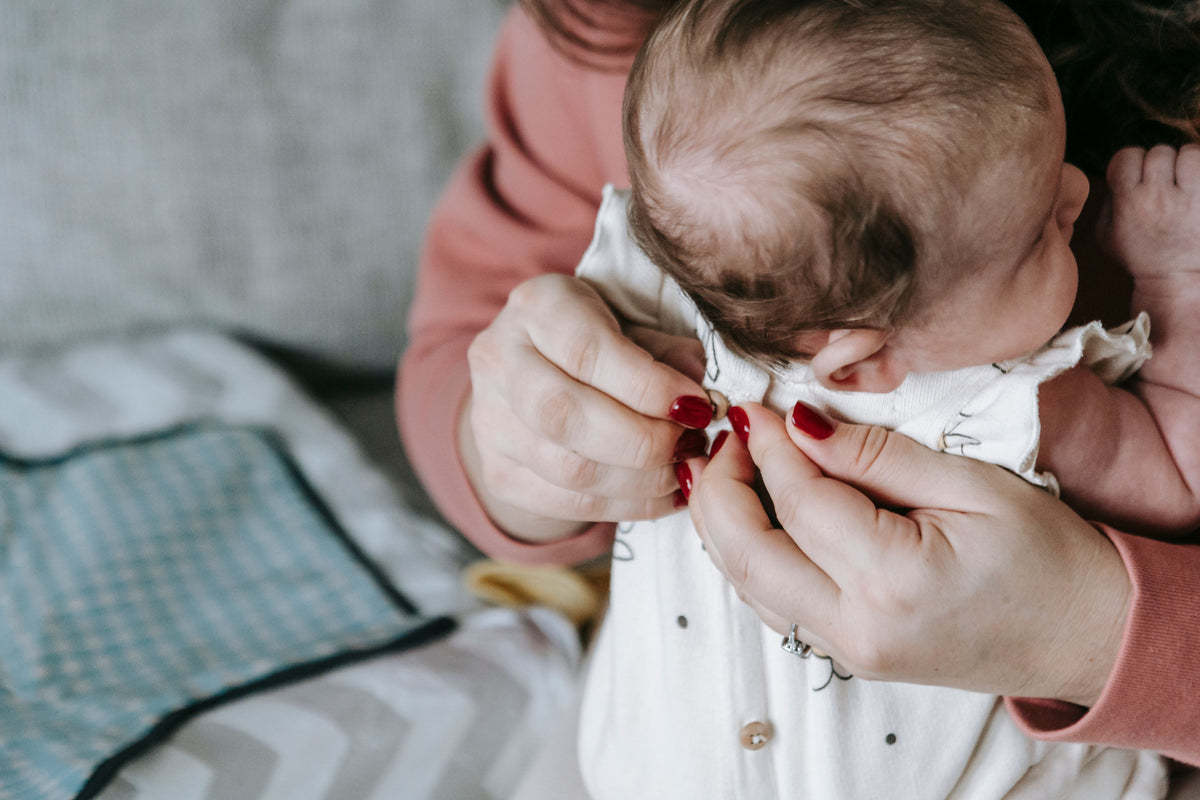
The fresh outfit is ready. Then come the little kicks, the turning shoulders and the question every caregiver knows: where does this piece open, and what do I need to fasten next?
In that moment, the opening is not a tiny construction detail. It shapes the sequence of the whole change. Before you compare colours or prints, it is worth looking at how the garment opens, where your hands need to go and how many different fastening actions the design asks you to repeat.
Start with the path the garment gives you
Open the garment fully and imagine the change from beginning to end. Does the opening run down the front, sit at the shoulder or stop part-way? Can you see both sides of it while the baby is lying down? A visible front opening can make the next step easier to understand because the fastening path stays in view.
This is especially useful when more than one person dresses the baby. A parent, grandparent or other caregiver may each have a different routine, but a clear opening gives everyone the same place to begin.
Compare the movement, not only the closure name
Different closures ask your hands to do different things:
- Magnetic closures: bring the corresponding fastening points together so the two sides meet along the opening.
- Zips: connect the starting parts, then move the slider along the chain. YKK explains that the slider meshes the zipper elements as it moves.
- Press studs: line up each pair and press them closed, usually one after another.
- Buttons: guide each button through its buttonhole.
No one closure is automatically the right answer for every family. The useful question is which motion feels most natural for the people who will use the garment regularly.
Five details to check before choosing
- Where does the opening begin and end? A product photo should let you see how much of the garment opens.
- Can you understand the fastening path at a glance? Look for clear front, back and open-garment views rather than relying on a styled photo alone.
- What movement closes it? Bringing two points together, sliding, pressing or threading can feel quite different during a wriggly change.
- Who will dress the baby? Think about the everyday preferences of parents and other regular caregivers instead of assuming everyone likes the same closure.
- Are the instructions easy to find? Check the actual garment's sizing, care and safety guidance rather than carrying assumptions from another product.
How Soso Snaps changes the fastening step
Soso Snaps uses hidden magnetic closures along a visible front opening. Instead of threading buttons through buttonholes or pressing a row of studs, you bring the corresponding points together along the front.
That small construction choice does not remove the need to pay attention while dressing. What it can do is make the fastening sequence more direct: the opening is in front of you, the two sides meet, and the closure points connect along that path. If that movement suits your routine, it may be a detail you appreciate again and again.
For a fuller explanation of the mechanism and comparisons, read why magnetic baby clothes can make dressing simpler. For concise precautions and the research context, keep our calm magnetic-clothing safety guide nearby.
A quick decision rule
When you are comparing baby clothes, pause before the print and ask: Can I see the opening, understand the motion and picture the people in our home using it?
If the answer is yes, you are choosing from your real routine—not only from a product name. That is the kind of little, thoughtful change behind Soso Snaps.
Explore Soso Snaps and join our launch news. SOSO & CO. is still in prelaunch, so this is an invitation to discover the collection and stay in the little world we are building.
Featured photograph: Sarah Chai on Pexels.